There is a scene every vet knows by heart. The caregiver says: "everything was fine just yesterday, it happened suddenly". And then the examination shows that "suddenly" had been going on for weeks.
That is not the caregiver's fault. That is the cat's talent.
A cat that shows weakness becomes a target in nature – so evolution trained cats to be world champions in one discipline: pretending everything is fine. Your cat will not tell you it hurts. They will do everything so that you do not notice. Which is why rule number one of this article is: if a cat's pain is visible to the naked eye, it has almost certainly been going on for a long time.
The good news: cats cannot lie perfectly. They leave traces. You just need to know where to look.
Pain in a cat is not one symptom. It is a mosaic of small things
Forget the movie image of a sick animal lying down and crying. Pain in a cat looks different: several small changes at once, each of which seems innocent on its own.
Go through this list and count how many points match your cat compared with how they were a month ago – because the reference point is always their own normal, not "cats in general":
Movement
- stopped jumping where they always jumped (windowsill, worktop, your bed) or gets there "in stages", via a chair,
- goes down the stairs differently – sideways, slower, with stops,
- lies around more, patrols the flat less.
The litter tray
- goes next to the tray instead of in it (a very common sign of joint pain – the high edge of the tray has suddenly become an obstacle),
- sits in the tray for a long time with no result – warning: a male cat that cannot urinate is a life-threatening emergency; you go to the clinic immediately, not in the morning.
Coat and grooming
- stopped grooming – the coat is dull, matted, "clumpy", especially on the back and rear, where bending is needed,
- or the opposite: obsessively licks one spot, sometimes down to bare skin.
Contact and character
- hides in places they never used to sit, chooses dark hiding spots,
- avoids touch, hisses or growls when you stroke an area that never bothered them before,
- a gentle cat becomes irritable – or a little devil suddenly becomes "well-behaved".
Food and voice
- eats less, approaches the bowl and walks away (a tooth may hurt – very common and notoriously missed),
- meows differently than usual or purrs at odd moments – purring does not mean everything is fine; cats also purr to calm themselves in stress and pain.
One point from the list is an observation. Two or three points at once, lasting longer than a day or two – that is a phone call to the vet.
The pain posture: a silhouette that says everything
There is one thing worth recognising at first glance, because it means pain here and now: the so-called pain posture.
Picture a cat sitting "in a loaf" – but not the relaxed bread loaf, the tense version: back arched into a hump, front legs straight and propped, head low, paws tucked underneath, eyes half-closed. The cat sits like this for a long time, does not change position, does not react to things that always interested them. Often with ruffled fur to complete the picture.
The difference between a "cosy loaf" and the pain posture is tension: a relaxed cat is soft and round, a cat in pain is stiff and hunched, as if trying to take up as little space as possible. If you see the latter – do not wait to see "if it passes on its own".
The Feline Grimace Scale: pain written on the face (seriously, it works)
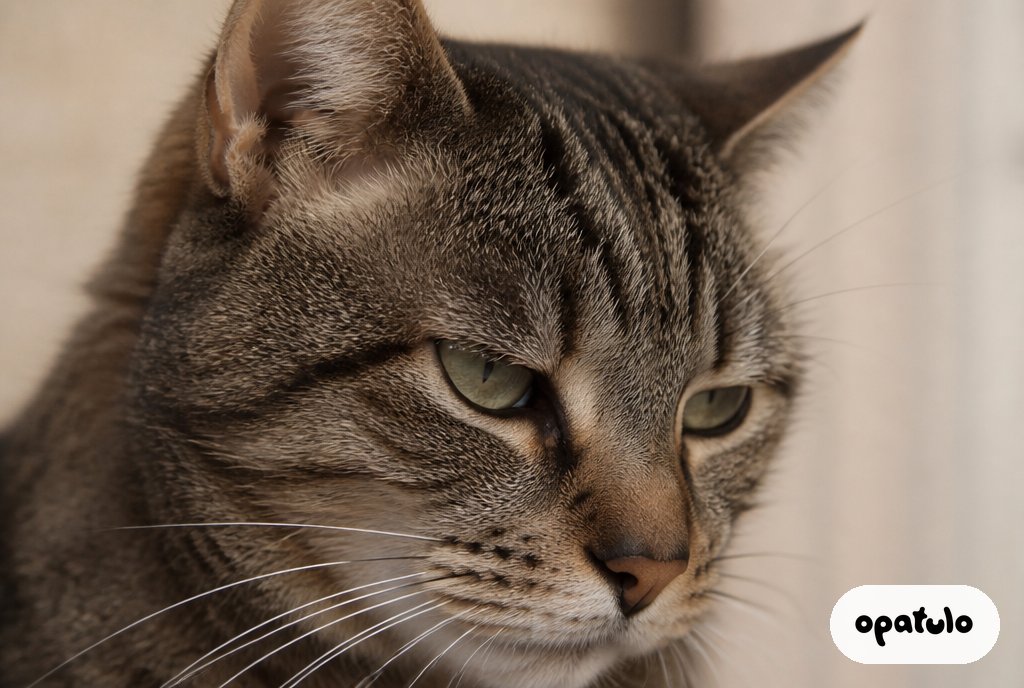
And now the concrete tool that changed veterinary medicine: the Feline Grimace Scale – a scientifically validated scale developed at the Université de Montréal. It turns out that pain shows in five places on a cat's face, and can be assessed in 30 seconds of observation from a distance.
Five points you score: 0 (normal) · 1 (slight change or unsure) · 2 (clear change)
- Ears – normal: facing forward. Pain: spreading apart, rotated outwards, looking "flattened".
- Eyes – normal: open, round. Pain: squinted, tense – not the same as the slow, sleepy squint of contentment.
- Muzzle – normal: soft, rounded. Pain: tense, "pinched", as if the cat were pressing its lips together.
- Whiskers – normal: loose, curving down to the sides. Pain: stiff, straight, pulled forward.
- Head – normal: above the shoulder line. Pain: dropped below the shoulder line, chin towards the chest.
A score of 4 points or more (out of 10) = your cat is most likely in pain and needs to see a vet. Important rules: observe the cat from a distance for about 30 seconds while they are calm – do not score while they are eating, grooming or vocalising, because the result will be skewed.
The Université de Montréal offers a free "Feline Grimace Scale" app (App Store and Google Play) with training photos – you can literally train your eye on examples. We recommend it to every cat caregiver, especially after surgery – we cover post-op care step by step in our guide to the first 48 hours after surgery.
What NOT to do when you suspect pain
The most important paragraph of this article
Never, under any circumstances, give your cat human painkillers. Paracetamol is poison for a cat – a fraction of a tablet can kill, because a cat's liver cannot break it down. Ibuprofen and similar drugs are dangerous too. "Half a tablet, it's such a small amount" is one of the most common causes of tragedies in clinics.
There is no safe home painkiller for cats. There is, however, a vet with medication designed for cats – and that is the only right path.
The second thing: do not "observe for weeks". A cat that has been eating less, hiding and not grooming for several days does not need another week of observation – it needs an examination. And a cat that does not eat at all for more than a day or two is an urgent case: in cats, fasting alone can trigger a dangerous liver disease.
Fridge cheat sheet
The pain signals and the grimace scale on one page – print it and stick it on the fridge.
- Golden rule: compare your cat with their own normal from a month ago. Pain = a mosaic of small changes, not one symptom.
- Behaviour red flags: not jumping where they always did · going next to the litter tray · stopped grooming / licks one spot · hiding · avoiding touch · eating less · odd meowing or purring "for no reason".
- Check the face (30 s from a distance): ears to the sides? · eyes squinted? · muzzle tense? · whiskers stiff and forward? · head below the shoulders? The more "yes" answers, the sooner you call.
- Straight to the clinic: a male cat sitting in the tray with no result · no eating for more than 24–48 h · a pain posture that does not go away despite calm.
- Never: no human painkillers. None.
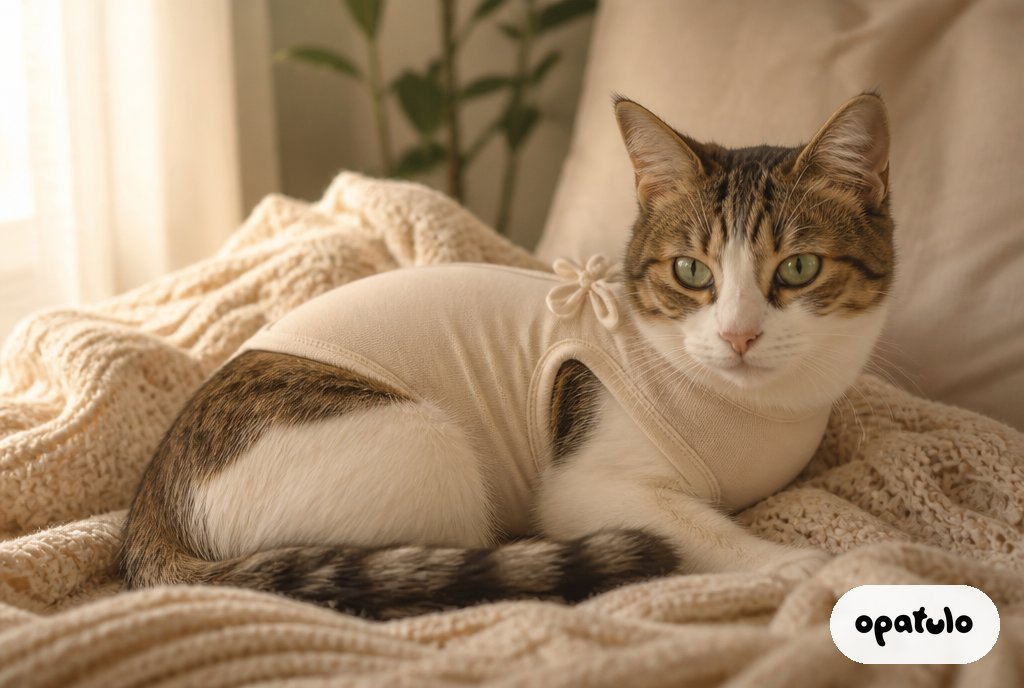
This guide was written at Opatulo – we accompany caregivers through the harder moments of pet care: we sew post-surgery recovery suits and teach first aid.
See the whole knowledge base